
Colorado’s New Price Transparency Law
What Home Service and Home Improvement Providers Need to Know About C.R.S. § 6-1-737.
If you run a plumbing, HVAC, electrical, roofing, remodeling, landscaping, or other home service or home improvement business in Colorado, a new state law is already in effect that directly governs how you advertise your prices and disclose your fees. House Bill 25-1090, now codified as C.R.S. § 6-1-737, took effect January 1, 2026, and was amended in March 2026. It applies broadly to anyone offering goods, services, or property for sale—and there is no exception for contractors or home service providers.
This post explains what the law requires, where home service businesses are most at risk, and what you can do right now to protect yourself.
What Is This Law, and Why Does It Apply to You?
The Colorado legislature passed HB 25-1090 to eliminate what is often called “drip pricing”—the practice of advertising a low headline price and then adding mandatory fees later. You have seen this in airline tickets, hotel booking sites, and subscription services. Colorado decided to address it across the board, and that means the law reaches home service and home improvement businesses just as readily as it reaches anyone else.
The statute defines “total price” as the maximum total of all amounts—including fees and charges—that a person must pay for a good, service, or property. The total price includes everything the customer cannot reasonably avoid paying. A violation of the law is treated as a deceptive, unfair, and unconscionable act or practice under the Colorado Consumer Protection Act, which carries real financial consequences.
The General Rule: Advertise the Total Price
The core requirement of C.R.S. § 6-1-737 is straightforward: when you offer, display, or advertise a price for your services, you must clearly and conspicuously disclose the total price as a single number, without separating that total into separate fees or charges. And the total price must be displayed more prominently than any other pricing information.
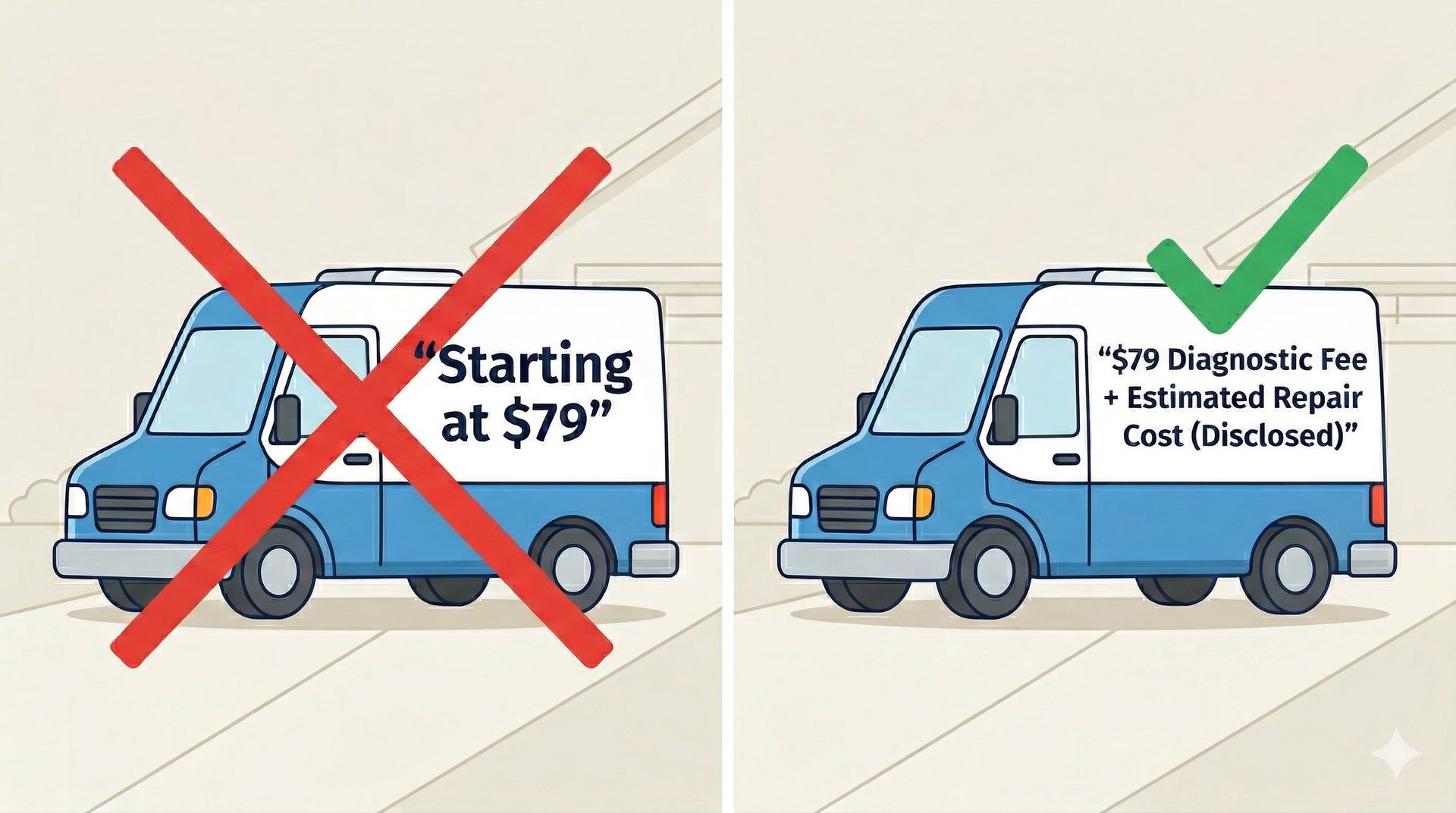
That means advertising language like “starting at $79,” “$149 + parts and labor,” or “service call fee: $95, repairs quoted separately” is potentially problematic under the law as written—unless you fall within the safe harbor discussed below.
If you offer a truly fixed-price service—say, gutter cleaning for a flat $250 that covers everything—the compliance path is simple: advertise $250 as the total price, prominently, and do not break it into component fees in your advertising. Any optional add-on (such as gutter guard installation) that the customer does not have to purchase is a “reasonably avoidable” charge that does not need to be bundled into the advertised total price. But if there is a disposal fee or trip charge that every customer pays regardless, that amount must be included in the number you advertise.
The Challenge for Home Service Providers: When You Can’t Know the Total Price Up Front
Here is where the law gets more complicated for your industry. Unlike a retailer selling a product at a fixed shelf price, a home service contractor often cannot know the total cost of a job before showing up, diagnosing the problem, or opening a wall. A drain cleaning might reveal a collapsed pipe. An HVAC tune-up might uncover a failing compressor. A bathroom remodel estimate might change once demolition reveals unexpected conditions.
The legislature recognized this reality, and the statute contains a safe harbor for exactly this situation.
The Safe Harbor: What You Must Disclose When the Total Price Is Not Yet Known
Under C.R.S. § 6-1-737(2)(b)(II), you are compliant with the total price requirement—even if you cannot state a single total price up front—if you can demonstrate that the total price of your services cannot reasonably be known at the time of the offer due to factors beyond your control, including factors that are determined by consumer selections or preferences, or that relate to distance or time. If you qualify, you must clearly and conspicuously disclose three things:
First, the factors that determine the total price. This means telling the customer, in plain language, what drives the cost: the extent of the damage found during diagnosis, the parts required, the number of hours of labor, travel distance, or whatever factors genuinely control the final number.
Second, any mandatory fees associated with the transaction. If you charge a service call fee, a diagnostic fee, a trip charge, or any other fee that every customer must pay regardless of the outcome of the job, that fee must be disclosed clearly and conspicuously. You cannot bury it in fine print.
Third, that the total price may vary. You must tell the customer, up front, that the price is not fixed and will depend on the factors you have disclosed.
Think of the safe harbor as a three-part checklist: explain what drives the price, disclose every mandatory fee, and make clear the final number is not yet determined. If you check all three boxes, you are in a much stronger compliance position.
What Counts as a “Mandatory Fee”?
This is the question your compliance depends on getting right. A mandatory fee is any amount the customer cannot reasonably avoid. Common examples in the home services industry include:
A service call or trip charge that applies to every job, regardless of whether repairs are made. If you charge $95 to come out and diagnose an appliance, that $95 is mandatory and must be disclosed.
A diagnostic fee that you apply even if the customer declines the repair. If the customer cannot walk away without paying something, that amount is mandatory.
A disposal or haul-away fee that is automatically included in every job. If removing old equipment or debris is simply part of how you do business and customers cannot opt out, it is mandatory.
By contrast, optional add-ons—upgraded parts, extended warranties, premium service packages—that the customer can genuinely decline are “reasonably avoidable” and do not need to be disclosed as mandatory fees. The key question is whether the customer can actually say no and walk away without paying it.
Advertising Dos and Don’ts: Practical Examples
The following examples illustrate how the law applies to common advertising scenarios in the home services industry.
Fixed-price service, no variables. You advertise whole-house air duct cleaning for $299, which covers everything including the inspection and cleaning of all vents. The $299 must be your headline number. Do not advertise “$199 + $100 equipment fee.” Display $299 clearly and prominently.
Service call with variable repair costs. You advertise HVAC repair services and charge a $99 diagnostic fee that every customer pays, with repair costs quoted after the diagnosis. Advertising “HVAC Repair” without a price is fine as long as your website, ads, or any price representation you make discloses: (1) the $99 diagnostic fee as a mandatory fee, (2) the factors that will determine the total repair cost (extent of damage, parts needed, labor time), and (3) that the total price will vary. The moment you put a dollar figure in your advertising—even a starting price—the safe harbor disclosure obligations are triggered.
Written estimate for a remodeling project. You provide a written estimate for a kitchen remodel that you tell the customer may change based on what you find during demolition, material selections, and any scope changes. Your estimate is not the same as an advertised fixed price, and the safe harbor is available. But your estimate should clearly state what mandatory fees apply (permit fees you will charge, your markup on materials if it is not optional, and any draw schedule requirements) and should plainly state that the final price may vary based on the conditions you discover.
Subscription or maintenance plan. You offer an annual HVAC maintenance plan for $149 per year. If that $149 is all-inclusive, advertise it as the total price. If there are additional charges for refrigerant, parts, or service calls that plan members must pay, those are not reasonably avoidable and should be either included in the total price or, if variable, disclosed under the safe harbor.
Misrepresenting Pricing Information Is Also Prohibited
Beyond the total price requirement, C.R.S. § 6-1-737(3) separately prohibits misrepresenting the nature and purpose of pricing information. This means you cannot misrepresent whether an amount is refundable, misidentify what a fee is for, misstate who receives a fee, or misrepresent the actual price. Before a customer agrees to pay, you must clearly disclose the nature and purpose of any charges that are not part of the disclosed total price.
In practical terms, this means that if you charge a “convenience fee” for credit card payments, you need to be clear about what it is, who receives it, and whether it is refundable. You cannot call a mandatory overhead charge an “administrative fee” and leave the customer guessing about what it covers.
Consequences of Non-Compliance
A violation of C.R.S. § 6-1-737 is treated as a deceptive, unfair, and unconscionable act or practice under the Colorado Consumer Protection Act. The remedies available to aggrieved customers are significant.
A customer who believes you have violated the law can send you a written demand for reimbursement of fees paid in violation of the statute, actual damages, and a demand that you stop the violating practice. If you do not make full payment or cease the practice within fourteen days of receiving that demand, you become liable for actual damages plus eighteen percent interest, compounded annually. Customers do not need to satisfy any pre-suit requirement before asserting a claim. The Colorado Attorney General also has enforcement authority under the statute.
This is not a hypothetical exposure. As consumers and plaintiffs’ attorneys become aware of the law, the risk of receiving a demand letter—or a lawsuit—will grow. The compliance cost of reviewing and updating your advertising and disclosures is far lower than the cost of defending a claim.
Steps You Should Take Now
First, audit your advertising. Review every place where you display pricing information—your website, Google Business Profile, Facebook page, printed flyers, vehicle wraps, and any other medium. For each price you display, ask whether it represents the true total price a customer will pay, or whether there are mandatory fees on top of it. If there are, either include them in the total price or implement the three-part safe harbor disclosure.
Second, review your service agreements, estimates, and invoices. Make sure that your written agreements clearly identify any mandatory fees, explain the factors that determine the final price when applicable, and state that the price may vary if the safe harbor applies to the service you are providing.
Third, train your staff and technicians. The people taking calls, sending quotes, and collecting payment are the front line of compliance. They need to understand that they cannot quote a starting price without the required disclosures, and that every mandatory fee must be disclosed before the customer agrees to pay.
Fourth, when in doubt, disclose. The statute rewards transparency. A clear, upfront disclosure of your pricing structure—what is mandatory, what varies, and why—is both good business practice and your best legal protection.
How Coakley Law Can Help
C.R.S. § 6-1-737 is a new and evolving area of law. The statute is broadly written, and its application to the home services industry will develop over time through enforcement, guidance from the Attorney General, and litigation. Getting ahead of compliance now is the right move.
Coakley Law works with Colorado contractors and home service businesses on a range of legal matters, including contract review, regulatory compliance, and dispute resolution. If you would like a review of your advertising and service agreements to assess compliance with C.R.S. § 6-1-737, or if you have received a demand letter related to your pricing practices, we can help. Contact our office at (303) 500-1778 or visit us at coakleylaw.com.
THIS IS NOT LEGAL ADVICE. This blog post provides general information about C.R.S. § 6-1-737 and does not constitute legal advice. The application of this statute to specific situations depends on individual facts and circumstances. Home service and home improvement providers should consult with qualified legal counsel regarding their particular compliance obligations.