Coakley Law Firm Blog

Useful Info and Resources

on Cases and Laws

News

By Eric Coakley January 14, 2026
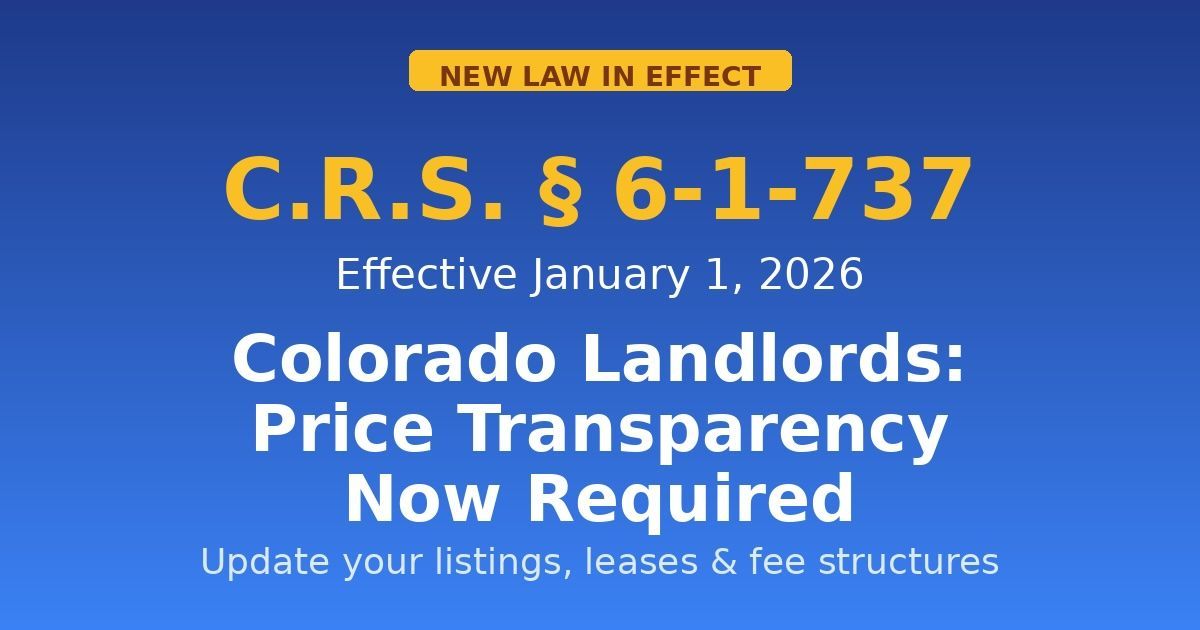
As of January 1, 2026, Colorado landlords are operating under one of the most comprehensive pricing transparency laws in the country. House Bill 25-1090, now codified as C.R.S. § 6-1-737, fundamentally changes how residential rental properties must be advertised and how fees can be charged to tenants. If you own or manage rental property in Colorado, understanding this law is no longer optional—it's essential to avoid significant liability. What Is C.R.S. § 6-1-737? Colorado's legislature passed HB 25-1090 to eliminate “drip pricing”—the practice of advertising a low base price and then adding mandatory fees later in the transaction. While the law applies broadly to many industries, it contains specific provisions targeting residential landlords. The stated purpose is to ensure renters can understand the true cost of housing without navigating through layers of additional charges. The “Total Price” Requirement Under the new law, when you advertise a rental property, you must display the “total price” clearly and conspicuously. This total price must include all mandatory fees that a tenant cannot reasonably avoid, and importantly, the total price must be displayed more prominently than any other pricing information. The total price must include base rent plus any fee that all or most tenants must pay, such as trash removal fees, included utility fees, pest control fees, administrative fees, and pet fees. Excluded from the total advertised price are governmental fees or taxes and utility costs when the tenant is individually metered. The total price also need not include fees that are “reasonably avoidable” by the tenant. A “reasonably avoidable” fee is a fee that is optional. For example, if a tenant may pay an additional fee for garage parking but is not required to do so and other off- or on- street parking is available, then such a fee is reasonably avoidable and need not be included in the advertised total price. Specific Restrictions on Fees Landlords May Charge Beyond the advertising and disclosure requirements, Colorado law now prohibits or caps several types of fees commonly charged by landlords. C.R.S. § 6-1-737 prohibits fees for services the landlord doesn't actually provide and prohibits rent payment processing fees unless the tenant has at least one fee-free payment method available. The statute also prohibits charging late fees on anything other than rent itself. Additionally, C.R.S. § 38-12-801(3)(a)(VI) caps markups on third-party costs that are passed through to tenants. If you're billing tenants for services provided by a third party—such as water billing services, valet trash, or similar amenities—any markup you charge is limited to either $10 per month or 2% of the underlying cost. You cannot charge both. Special Considerations for Utility Billing The statute contains detailed provisions about utility billing that warrant particular attention. Landlords generally cannot require tenants to pay for utilities above the amount charged by the service provider to the tenant's unit, except for the limited administrative fee discussed above (either $10 per month or 2% of the bill, but not both). However, if you use submetering to bill tenants for their actual individual usage, those variable utility charges are excluded from the “total price” disclosure requirement. Many Colorado properties use master meters and Ratio Utility Billing Systems (RUBS) to allocate utility costs among tenants. In November 2025, the Colorado Attorney General issued guidance indicating that enforcement would be flexible for existing properties using master meters, recognizing that requiring individual meters could impose prohibitive retrofit costs. The AG's guidance acknowledged “significant uncertainty” in the statute's application to these systems and noted that penalizing properties using master meters would be “contrary to the intent of HB 25-1090.” The AG also indicated that a legislative fix is expected during the 2026 session. Landlords using RUBS or master meter systems should monitor developments closely as the legislature considers clarifying amendments. Consequences of Non-Compliance Violations of C.R.S. § 6-1-737 are considered deceptive, unfair, and unconscionable trade practices under the Colorado Consumer Protection Act. The remedies available to tenants are significant and should not be underestimated. Tenants can send a written demand for reimbursement of unlawfully charged fees, for actual damages, and demanding that you cease the violating practice. If you don't comply within 14 days of receiving such a demand, you become liable for actual damages plus 18% interest, compounded annually. Tenants may also refuse to pay prohibited fees and notify you of their refusal. Any lease provision that violates the statute is void. Additionally, the Colorado Attorney General has enforcement authority and can bring actions against landlords who violate the law. What steps should landlords take now? C.R.S. § 6-1-737 represents a significant shift in how Colorado landlords must structure and communicate their pricing. The law is new, and we can expect additional guidance, potential legislative amendments, and likely litigation that will clarify ambiguous provisions over the coming months and years. There are a few steps you, your management company or your attorney should take immediately to be sure you are in compliance: First, review all lease agreements and identify every fee you charge. Determine which fees must be included in advertised rent and which fees may need to be eliminated or restructured. Remember that lease provisions violating this statute are void and unenforceable. Second, update all advertising immediately. Every rental listing, whether on your website, Zillow, Craigslist, a newspaper, bulletin board or on paper flyers must show the total price prominently. Eliminate language like “Rent: $1,500 + fees” or “Starting at $1,200.” The headline number must be the actual total amount a typical tenant will pay. Third, if you're billing for utilities, confirm your billing method and ensure compliance. If you're using submetering, document that tenants are being charged based on actual individual usage. If you're using RUBS or a master meter system, review the AG's guidance carefully and consider whether clarifying amendments from the 2026 legislative session may affect your practices. Marketing materials and lease documents must be consistent with the new law across your entire operation. For many landlords, the compliance burden is real. Fee structures that were standard practice in 2025 may now create substantial legal exposure. The upfront work required to ensure compliance—reviewing leases, updating advertising, restructuring fees, and training staff—is considerable but necessary. If you're uncertain about whether your current practices comply with C.R.S. § 6-1-737, or if you need assistance restructuring your leases and fee schedules, Coakley Law can help. Our firm works extensively with Colorado landlords and understands both the practical realities of property management and the legal requirements you must navigate. THIS IS NOT LEGAL ADVICE. This blog post provides general information about C.R.S. § 6-1-737 and does not constitute legal advice. The application of this statute to specific situations depends on individual facts and circumstances. Landlords should consult with qualified legal counsel regarding their particular compliance obligations. 
By Eric Coakley June 23, 2025
Here's the Due Diligence Every LLC Owner Should Do First
By Eric Coakley April 22, 2025
Steps Every LLC Owner Should Take
By Eric Coakley April 7, 2025
A step-by-step guide.
By Eric Coakley March 28, 2025
Choosing the right business entity is one of the most important decisions you’ll make as a new business owner. For the vast majority of small businesses, the Limited Liability Company (LLC) is the most practical and advantageous option. In this article, I’ll walk through why an LLC tends to be the best fit for small businesses—and why it’s often a better choice than other structures like sole proprietorships or corporations. What Is an LLC? A Limited Liability Company is a legal business structure that blends elements of sole proprietorships, partnerships, and corporations. It's recognized as a separate legal entity from its owner(s), providing liability protection while offering flexibility in taxation and management. Key Benefits of an LLC for Colorado Entrepreneurs 1. Limited Liability Protection Forming an LLC creates a legal separation between you and your business. This means that if your business is sued or goes into debt, your personal assets (like your home or car) are generally protected so long as you follow the simple rules for operating an LLC. For solo business owners or small teams, this peace of mind is essential. 2. Ease of Formation Setting up an LLC in Colorado is quick, simple, and inexpensive. You can file the necessary documents (like your Articles of Organization) online with the Colorado Secretary of State in less than 30 minutes. There’s no need to hire an attorney to get started, though legal guidance can help tailor the setup to your specific needs. 3. Tax Flexibility Unlike corporations, LLCs are not taxed as separate entities by default. Instead, profits and losses “pass through” to the owners’ personal tax returns. This avoids double taxation and can offer real tax advantages. If needed, an LLC can even elect to be taxed as an S Corporation or C Corporation, giving you further flexibility as your business grows. 4. Fewer Formalities Compared to corporations, LLCs come with fewer and simpler administrative requirements. For example, you don’t need to hold annual shareholder meetings or keep extensive records of corporate resolutions as you would if you formed an Inc. This is important because a failure to adhere to the administrative requirements of the entity you choose can put your personal assets at risk. 5. Professionalism and Credibility Operating as an LLC can enhance your business’s credibility. Clients, vendors, and partners may feel more comfortable working with a registered business entity. It also makes it easier to open business bank accounts, apply for loans, and bring on partners or investors. 6. Ownership and Continuity LLCs can have one or multiple owners (called “members”) and allow for flexible arrangements in how profits, responsibilities, and decision-making are divided. If structured properly in an operating agreement, the business can continue even if a member leaves or passes away. Why Not a Sole Proprietorship? A sole proprietorship is the easiest structure to start—but it offers no liability protection. You and your business are legally the same, which means your personal assets are at risk if anything goes wrong. You’ll also miss out on some of the credibility, financing options, and tax benefits an LLC can provide. Why Not a Corporation? Corporations make sense for some businesses, particularly those seeking outside investors or planning to go public. But for most small operations, the corporate formalities, rigid structure, and potential for double taxation make them less appealing than LLCs. The LLC offers similar protections with far more simplicity. Final Thoughts An LLC hits the sweet spot for many small business owners in Colorado: It’s affordable, flexible, and protective. While every situation is unique, most entrepreneurs can benefit from starting out with an LLC—and adjusting as needed as the business evolves. In future posts, I’ll break down how to set up an LLC in Colorado, how to write an operating agreement, and when to consider other structures. If you have questions about your specific situation, feel free to comment or reach out directly.
By Eric Coakley March 12, 2025
When I think of a business starting up, I imagine an explorer’s ship preparing to set sail. Each business is unique, with uncharted waters to navigate, perils to avoid, and adventures to embrace. The entrepreneur, our captain, leads the preparations from the quarterdeck. Barrels of salted meat, hardtack, and fresh water are rolled up the gangplank, their heavy thuds echoing against the planks. The sweet-sharp smell of tar rises as carpenters seal the seams of the hull. Each creak of the ship’s timbers, each shout from the sailors rigging the sails, is a reminder of what one forgotten supply, one poorly sealed seam, could mean. A map on the cartographer’s table marks the end of the known world with a bold, ominous line. Beyond it, a mysterious warning: Here Be Dragons. This is the moment of enless possibility and unknown risk. What awaits beyond the horizon? Will our captain discover lands of untold riches, or will the journey end on reefs that splinter the dream into driftwood? What dangers lie beneath the seas, hidden and waiting for the unprepared? At our firm, we act as the guide for small businesses, ensuring their ventures are equipped to weather storms and seize opportunities ahead.  Join us in the coming weeks for our series on avoiding the legal perils a small business faces. From choosing the right business structure to navigating operations, sales, and the eventual closing or sale of your business, we’ll help you navigate the complexities of business ownership with confidence. With us as your legal guide, your business can set sail toward success.